


Explore how personalized search helps B2B buyers find the right products faster and improves product discovery across large, complex catalogs.

This blog post is written in collaboration with our partner, Emerce
Over the past few years, B2B ecommerce companies have made major strides online. Cleaner design, more intuitive navigation, and better usability have taken ecommerce sites to a higher level. Even so, customers still often struggle with product discovery, even when the site design is solid. Personalization can solve that search problem.
B2B ecommerce companies such as wholesalers often have huge, complex product catalogs. A single type of washer, for example, can easily come in more than 200 variations because of different diameters, materials, and colors. That makes it hard for customers to find the right product fast.
On top of that, not every B2B customer is a procurement specialist. Many buyers are installers, technicians, or project staff. An installer usually knows what size washer is needed for a certain type of boiler, or maybe a few digits from the part number, but not always the exact product. They want to find something that matches their need quickly, without spending hours digging through a catalog.
The problem with the traditional, non-personalized search function
To help customers find the right products, most B2B companies start by focusing on site design and implementing a traditional search function. This kind of search filters products based on material, diameter, weight, color, and so on. If someone types in a search term like “washer,” they will always see the same list of products.
A traditional search function seems like an ideal solution because the results are predictable for the business, and it gives them control over what is shown.
In practice, it is more complicated than that. One installer may be looking for a 20-millimeter steel washer, while another needs a 22-millimeter stainless steel version.
Personalization as the answer to the search problem
With personalized search, customers can find the right products much faster. Instead of showing a fixed list of search results, the search engine adapts based on the buyer and the company they work for. An AI-driven search function looks at factors such as:
- Order history
- The customer’s click and search behavior in the web store
- Orders placed by colleagues at the same company
Based on that information, the search engine uses behavioral signals and intent-aware ranking to adjust results in real time. An installer who always buys 20-millimeter steel washers will see those products at the top. A technician who often chooses stainless steel versions will see those products appear more prominently in the results.
One of the biggest advantages is that the search engine uses machine learning to learn from every search, click, and order. That makes the experience more relevant over time and helps users complete their orders faster.
To learn more about the mechanisms behind Relewise Personalized Search, click here.
Logged-in users are untapped potential
Very few B2B companies are using recommendations throughout the customer journey, even though that is where major opportunities exist. Most of their customers log in to the web store, which means you have access to individual order data and can act on it.
Say an installer finds the right type of washer and places an order. During checkout, or when sending the invoice, you can recommend products that other customers often bought to finish the job. Or if someone almost always orders the same products and leaves one of them out, you can recommend it in real time.
You can also respond to repeat purchases. If you know a product usually needs to be replaced after a year, you can remind the buyer at the right time and potentially include a relevant offer.
Ahlsell: An example from Scandinavia
A strong example is Ahlsell, the largest technical distributor in Scandinavia, with more than 430,000 products for the industrial and construction sectors.
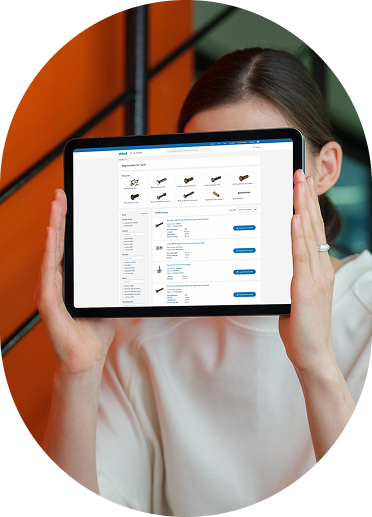
By implementing an AI-powered personalized search function with intent-aware ranking in its ecommerce site, Ahlsell made it easy for customers to search by product number, name, or size. As a result, customers can quickly find what they need, while the sales team has also improved operational efficiency and day-to-day customer interactions.
It's no longer a nice-to-have, folks
Many B2B companies still hesitate to invest in personalization because it sounds almost too good to be true. But business buyers are not shopping for fun. They are buying because they need something. That is exactly why they want active help.
By implementing personalization, you make sure buyers are not overwhelmed by irrelevant results. Instead, they see products that match the needs of their business. That helps them find the right products faster, which leads to higher conversion rates and more opportunities for upselling and cross-selling.
The barrier to getting started is also fairly low. More and more solutions can be integrated into existing systems without requiring a complete rebuild of your architecture. That also makes it possible to start with a small project, measure the impact, and scale from there.
A personalized search function is no longer just a nice-to-have. It is an essential part of any successful ecommerce strategy. B2B ecommerce companies that are willing to give up some control over what customers see in their online store will build stronger customer relationships over time and drive more revenue.